Why Your Scented Candle Is Hurting Your Family — And You Don't Realise It
Most people don't know what they're actually burning in their home. One Dutch journalist read every label in her cupboard. What she found changed how she lives.
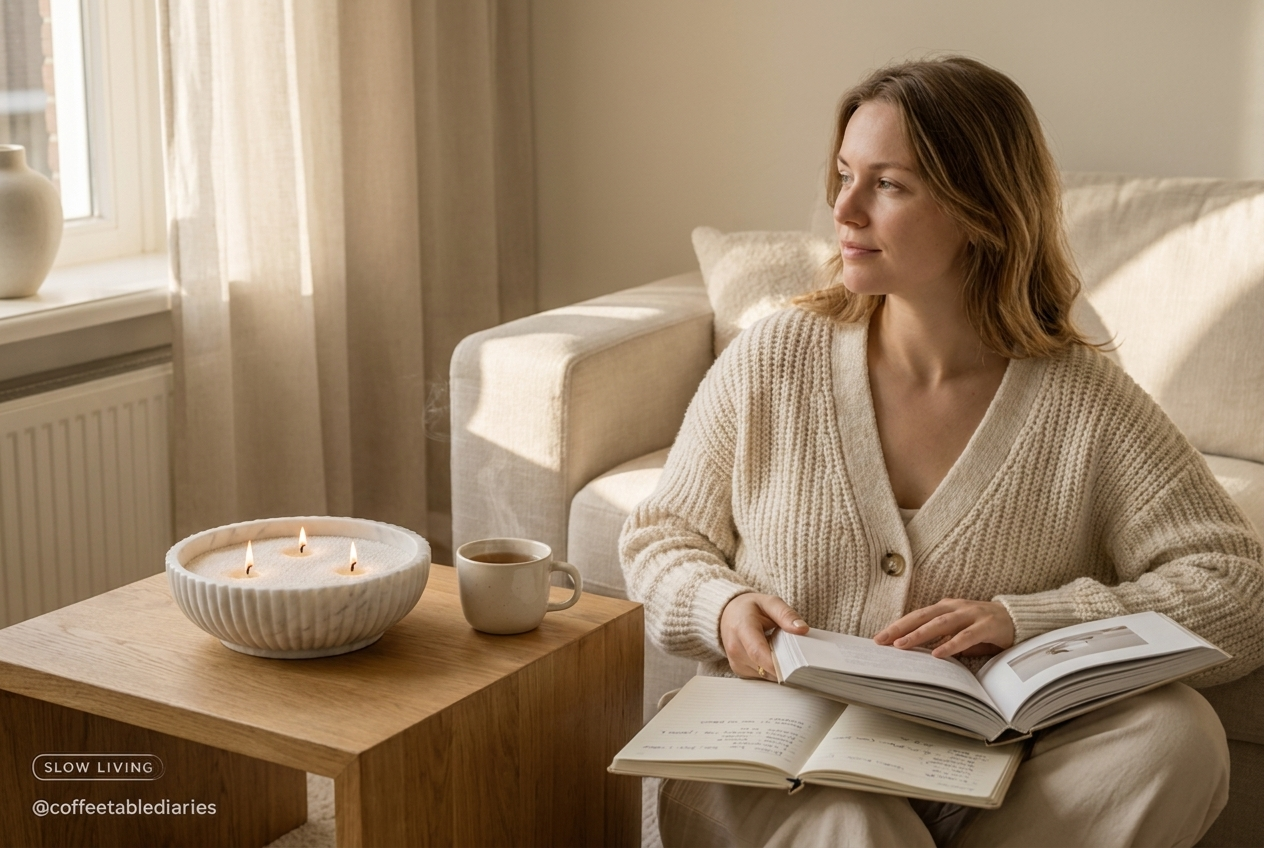
It was a Wednesday in February. The kind of evening you'd describe as quiet if you were trying to sell it. Olivier was asleep upstairs. My husband was making tea. I'd just put my laptop away.
I lit my favourite candle.
You know the one — the small glass jar, the embossed silver label, the scent that costs around €52 in the boutique on the corner. Sandalwood and amber. The kind of candle that makes you feel like it's already Sunday morning, even if it's actually Wednesday and there's a load of laundry waiting.
That's when Olivier started coughing.
It wasn't dramatic. Two small coughs from his bedroom, the kind that don't even wake a parent up. I assumed it was nothing. He's almost three. He coughs.
But ten minutes later, I'd put the candle out anyway. Just in case. And then I did something I'd never done before in my four years of motherhood.
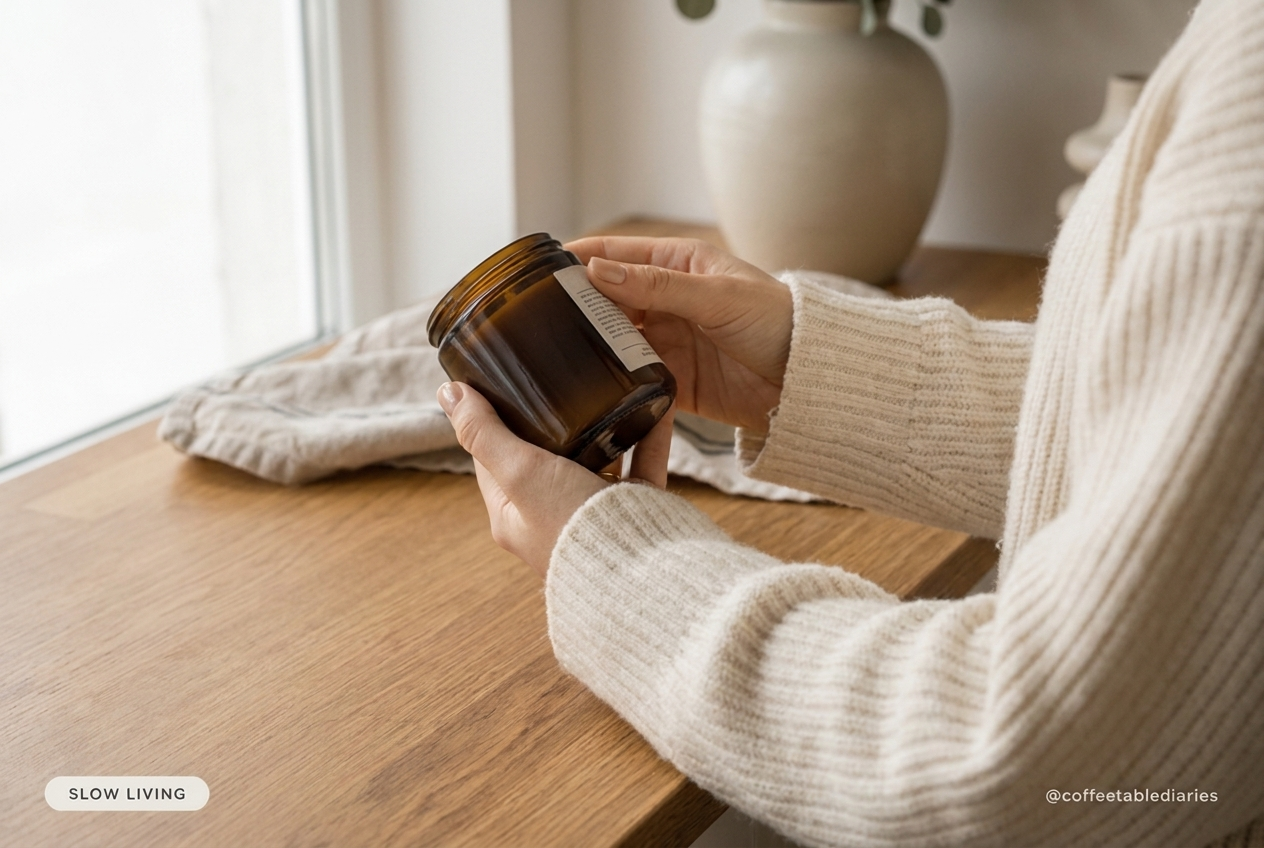
I picked the candle up. I turned it around. I read the label.
I am a journalist who reads labels.
I'd been a journalist for nine years before I had Olivier. I'd written about food labels for three Dutch publications. I'd taught myself how to spot every additive that doesn't belong in my child's body. I'd read the back of every yogurt cup. I'd thrown away cleaning products with synthetic fragrance. I'd switched detergent twice.
But my candles? Never.
The label on the back of mine said three things: "fragrance," "paraffin," and a Latin word I didn't recognise. I googled the Latin word. It was a synthetic fixative. Then I googled "what's in candles."
The first result was the Cleveland Clinic.
Reading time: four minutes.
Reading impact: I haven't lit that candle since.
Here's what I found.
I am not a chemist. I'm a wellness journalist with too much free time on a Wednesday night. But here, in plain language, is what I learned about scented candles in the next four hours.
Most scented candles are made of paraffin wax. Paraffin is a byproduct of petroleum refining — yes, the same petroleum that goes into your car. When paraffin burns, it releases benzene and toluene. The Cleveland Clinic writes plainly: "Benzene is a known carcinogen linked to blood disorders such as leukemia. Toluene is a neurotoxin associated with dizziness, headaches, or more serious effects at prolonged exposures."
Most scented candles contain phthalates. Phthalates are the chemicals that help fragrance stay in the air longer. They are, according to the Environmental Working Group, "endocrine disruptors associated with reduced fertility, asthma, and developmental issues." A 2022 Washington Post investigation found that prenatal phthalate exposure has been linked to a 30 to 60 percent higher chance of asthma in children, and in one Norwegian cohort, a 300 percent higher chance of ADHD.
I read those numbers three times.
The word "fragrance" on a candle label is a legal black box. In the EU and the US, manufacturers do not have to declare which specific chemicals are in their "fragrance" formula. One mixture can contain up to one hundred different chemicals. None of which the brand is obligated to tell you about.
The black ring around the rim of your candle jar? That's soot — ultrafine particulate matter. The World Health Organization classifies it as a leading cause of indoor air pollution. The particles are small enough to enter your bloodstream through your lungs.
I sat at my kitchen counter for a long time after I read that.
I counted my candles.
The unsettling part wasn't the chemistry. I can read a study.
The unsettling part was how many candles I had in my house.
I counted them.
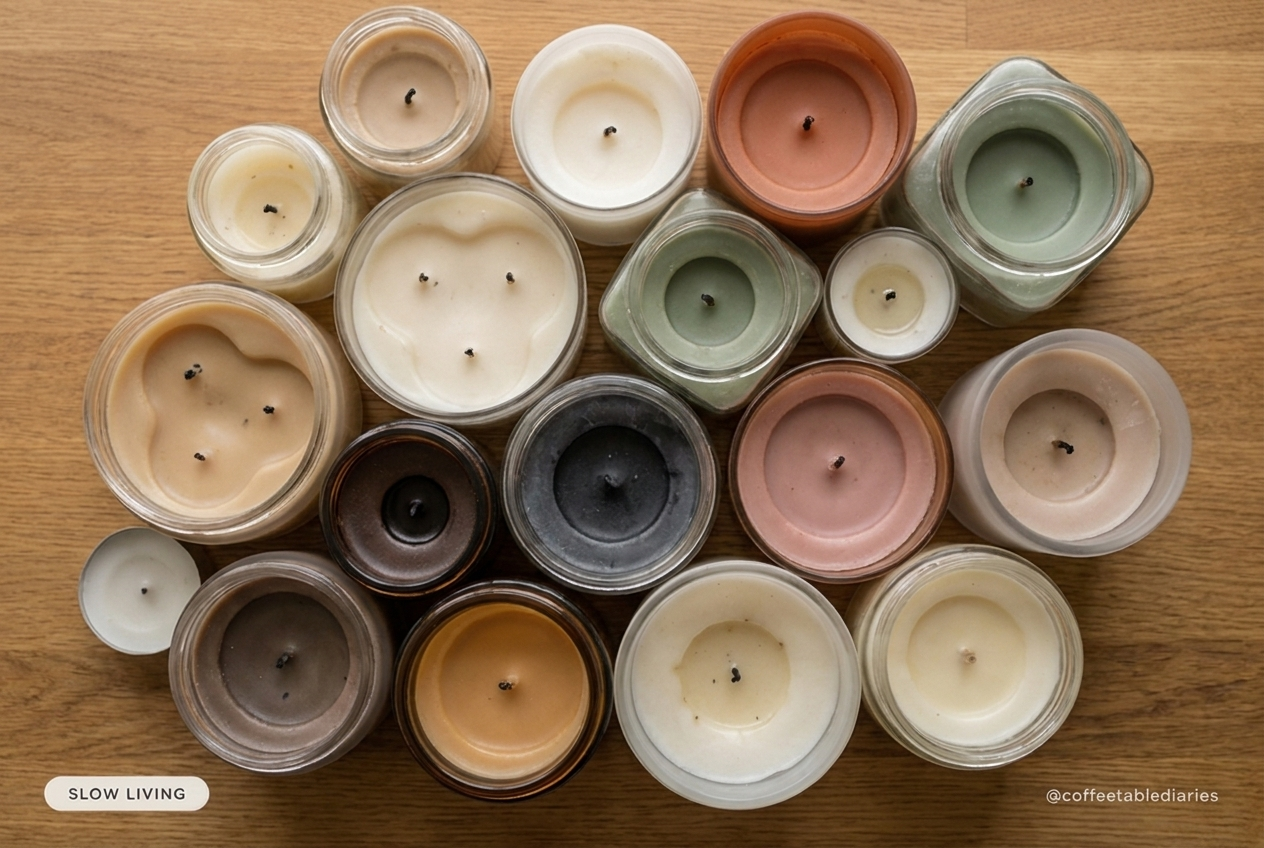
In the living room: four. In the bathroom: two. By my bedside: one. In Olivier's bedroom — yes, Olivier's bedroom — the small jar I'd bought him "for cosiness."
I threw them all out. Even the €52 sandalwood one. Especially the €52 sandalwood one.
I wasn't going to give up the ritual.
Here's the part where most articles like this stop. They tell you the problem. They wave vaguely at "natural alternatives." They move on.
But Olivier still likes candles. So do I. The ritual of lighting one at the end of the day is — and I'm using the word deliberately — sacred. I wasn't going to give that up because the candle industry has chosen not to disclose its ingredients.
So I started looking.
The first thing I learned: most "clean" candles aren't actually clean. The label says "natural" or "plant-based," but if you read the fine print, the wax is still 30% paraffin. "Made with soy" doesn't mean only soy. The word "essence" means nothing — it's not regulated. "Pure" means even less.
The second thing I learned: even the cleanest candles still throw away their jars. I had been burning candles for fifteen years. I had — and I'm not exaggerating — an entire kitchen cupboard of empty glass jars I couldn't bring myself to throw out and didn't know what to do with. The clean-candle industry has a burning problem and a waste problem at the same time.
I wanted both solved.
A friend in Amsterdam sent me a link.
The brand was called Coffee Table Diaries — a Dutch interiors community I already followed on Instagram for the styling content. I hadn't realised they made a product.
The product was called Alura. It was, somehow, pearled candle sand.
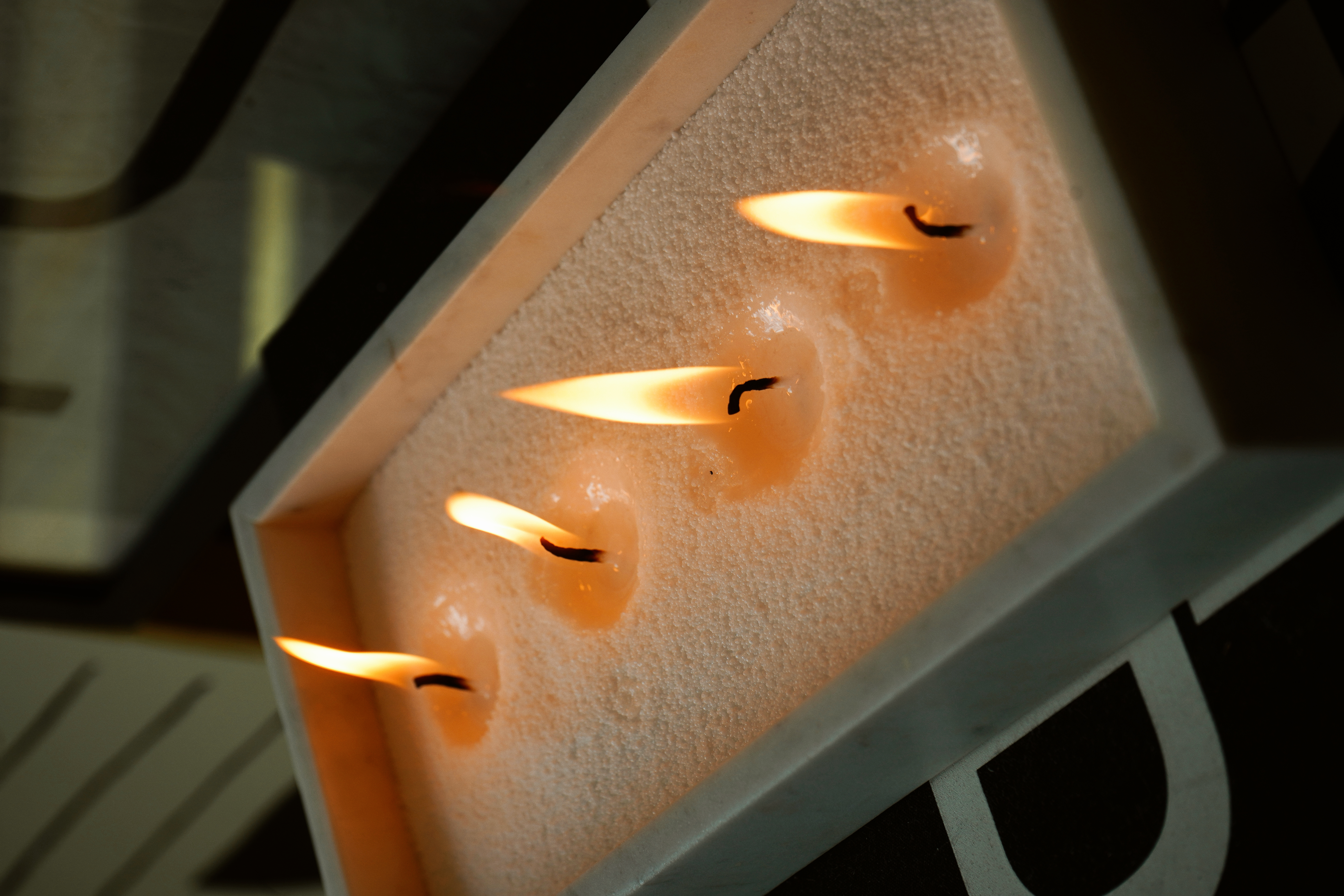
The concept took me a minute to understand. You pour the pearled wax into any heat-resistant vessel — a ceramic bowl, a glass cylinder, your grandmother's teacup, a marble dish. You add a wick (or several). You light it.
The pearls melt only around the flame. The rest stays granular. When the candle is finished, you don't throw away the jar — because there isn't one. You don't throw away the sand either. You refill the vessel, and the vessel stays.
I ordered one tube. €38. It arrived four days later in a cream cardboard tube with an orange band — minimal packaging, no plastic, no inserts I'd have to recycle.
The wax: 70% coconut wax (organic, Philippines) and 30% rapeseed wax (non-GMO, Netherlands). The optional scent oils — sold separately — are single-origin essential oils. The wick is 100% organic cotton, lead-free.
None of it is hidden behind the word "fragrance."
I poured it into a ceramic dough bowl I'd inherited from my grandmother. I'd been using it as a fruit bowl for six years. I added three wicks. I lit them.
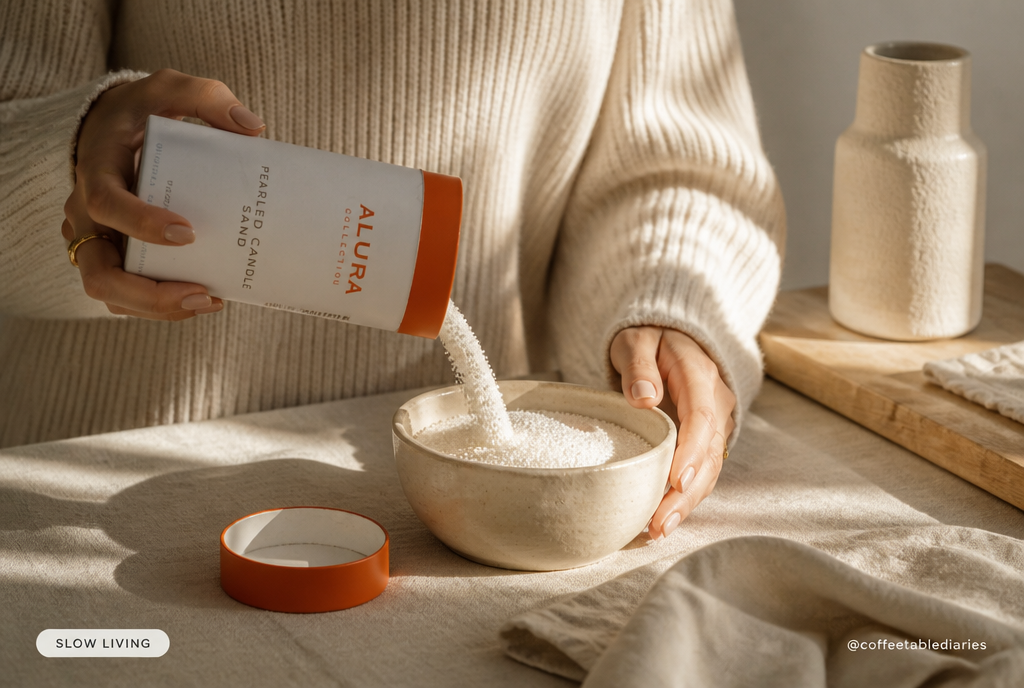
It smelled like nothing at first — and I realised, after fifteen years of paraffin candles, I'd forgotten what nothing smells like. Slowly, gently, the room filled with the smell of warm wax and the faintest hint of the lavender oil I'd added.
No synthetic fragrance bloom. No black soot ring. No fragrance headache the next morning.
Because I am a journalist, I asked.
I asked Coffee Table Diaries for their full ingredient breakdown. They sent it within two hours.
Burn time: 120 hours per tube. Then you refill the bowl.
A short note on the community.
I asked the Coffee Table Diaries team how many customers they had. They told me they don't really call them customers — they call them their community. The number, last I checked: 140,000 on Instagram.
I read through the most recent comments. The pattern was consistent.
This is the only candle I'll light around my baby.
I cancelled my Diptyque subscription.
My partner stopped getting headaches.
I felt less alone.
What I'm telling friends now.
When friends ask what candles I'm using these days — and they do, because by now Olivier and I are deep into Sunday-morning candle rituals — I tell them this:
You need to read the label.
If a candle's label doesn't list every ingredient, that's the candle telling you something. Listen.
Try Alura — Slow Home reader offer
One tube of Alura pearled candle sand at €34 (€4 off the standard price), with the option of a refill subscription. Pour it into a vessel you already love.
Try Alura →